


Even high-performance indoor air quality (IAQ) monitors cannot deliver meaningful data if they are installed in the wrong locations. Spaces that are close together do not necessarily share the same air quality conditions.
Effective IAQ monitoring begins with a well-designed placement strategy, not simply installing a certain number of devices per square meter.
This guide outlines the essential principles of IAQ monitor placement, including monitoring objectives, zoning, device quantities, installation heights, data validation, system integration, and equipment selection. It is intended for building designers, engineers, facility managers, and project teams.
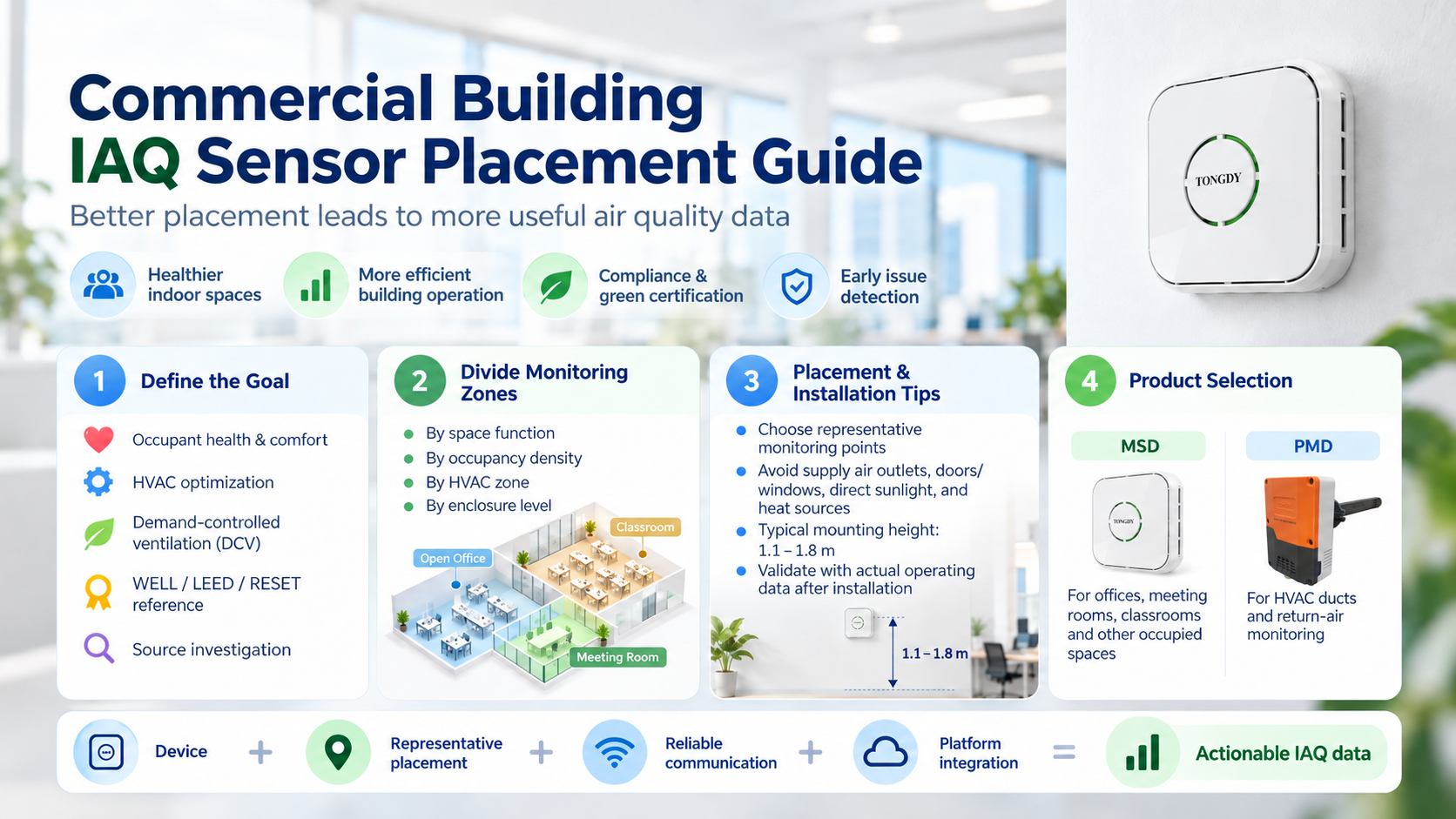
1. Define Monitoring Objectives and Applicable Standards
Before deciding where to install IAQ monitors, establish why the building needs air quality monitoring.
Common objectives include:
Occupant health and comfort: Understanding the air quality experienced by building occupants.
HVAC optimization: Evaluating ventilation performance and improving building operations.
Demand-controlled ventilation: Using real-time measurements to support ventilation adjustments.
Green building certification: Supporting applicable WELL, LEED, RESET, or other certification requirements.
Pollution source identification: Detecting abnormal air quality conditions and investigating potential sources.
The applicable standards, certification pathways, and their specific versions should be confirmed before placement planning begins.
Next, divide the building into appropriate monitoring zones based on:
Space layout and intended use
Occupant density
HVAC zoning and airflow patterns
Whether spaces are open or enclosed
Potential indoor pollution sources
Monitoring points should be selected to represent the air conditions experienced by occupants.
Avoid locations directly affected by supply air, as these may measure freshly supplied air rather than the mixed air within occupied spaces. Windows, doors, direct sunlight, heat sources, and nearby equipment can also influence measurements.
Key principle: IAQ monitor placement should be based on monitoring objectives and representative air conditions, rather than a fixed rule such as “one monitor per X m².”
2. How Many IAQ Monitors Does a Building Need?
There is no universally applicable monitor-per-square-meter formula for commercial buildings.
A more practical approach follows this sequence:
Applicable Standards → Space Function → Occupant Density → HVAC Zones → Enclosed Spaces → Pollution Sources → Representative Monitoring Points → Floor Area and Coverage
Floor area is a secondary consideration, not the starting point.
For example, an open-plan office, an enclosed meeting room, and an adjacent corridor may be located on the same floor, but each can have different occupancy patterns, ventilation conditions, and pollutant concentrations.
Therefore, their monitoring requirements should be evaluated separately, even when the spaces are physically close together.
The final number of monitors should reflect the building’s actual monitoring needs and any applicable project-specific requirements.
3. What Is the Best Installation Height for IAQ Monitors?
There is no single installation height suitable for every commercial environment.
Although 1.5 meters is sometimes used as a general reference, it should not be treated as a universal installation requirement.
The primary objective is to measure air quality within a representative occupant breathing zone.
Appropriate mounting height may vary depending on how people use the space:
Offices: Primarily seated occupants
Classrooms: Seated students and standing teachers
Lobbies: Primarily standing or moving occupants
Other commercial areas: Different occupant activities and exposure patterns
For projects pursuing WELL, LEED, RESET, or other certifications, mounting heights and monitoring locations must comply with the requirements of the applicable standard, version, and certification pathway.
4. Validate IAQ Data After Installation
Installing an IAQ monitor does not automatically mean the monitoring location is appropriate.
A complete engineering workflow should include:
Planning → Installation → Commissioning → Data Validation → Placement Adjustment
After installation, verify that the collected data reasonably reflects building operating conditions.
Key validation checks include:
CO₂ response to occupancy: CO₂ concentrations should generally respond to changes in occupancy and ventilation, rather than remain unexpectedly constant or fluctuate without an identifiable cause.
HVAC operating response: Changes in ventilation operation should produce reasonable responses in relevant monitored parameters.
Environmental interference: Investigate abnormal readings potentially caused by direct supply airflow, sunlight, heat sources, or nearby pollution sources.
Communication reliability: Verify stable data transmission, continuous monitoring, and successful integration with the monitoring platform or Building Management System (BMS).
If abnormal readings occur, inspect both the sensor’s operating condition and the suitability of its installation location.
A technically accurate sensor installed at an unrepresentative location can still produce misleading IAQ data.
5. What Makes a Complete and Reliable IAQ Monitoring System?
Proper monitor placement is only one part of an effective commercial IAQ monitoring strategy.
A reliable, long-term monitoring system should also provide:
Sensor accuracy and long-term stability: Consistent and dependable measurements over time.
Calibration and maintenance: Appropriate procedures to maintain measurement performance.
Multi-parameter monitoring: Measurement of relevant pollutants and environmental conditions.
Data continuity and reliability: Consistent data collection, transmission, and availability.
BMS/BAS/IoT integration: Connectivity with building automation and management platforms.
Maintenance accessibility: Practical access for inspection, calibration, servicing, and replacement.
The essential relationship can be summarized as:
Reliable IAQ Monitors + Representative Placement + Stable Communication + BMS/BAS/IoT Integration = Actionable IAQ Data
Reliable monitoring systems do more than collect numbers. They provide meaningful information that facility managers and building operators can use to evaluate ventilation performance, identify potential problems, and support long-term indoor environmental management.
6. Choosing the Right IAQ Monitoring Equipment
Different monitoring applications require different equipment configurations.
Tongdy MSD Series — Indoor Occupied-Space Monitoring
The Tongdy MSD series is designed for multi-parameter indoor air quality monitoring in occupied commercial environments.
Typical applications include:
Offices and meeting rooms
Building lobbies
Classrooms
Hotel guest rooms
Other occupied commercial spaces
Depending on the model and configuration, monitored parameters may include PM2.5, PM10, CO₂, temperature, relative humidity, TVOC, and formaldehyde (HCHO).
The MSD series supports monitoring of air quality conditions in areas where people work, study, gather, or spend extended periods.
Tongdy PMD Series — HVAC Duct Air Quality Monitoring
The Tongdy PMD series is designed for air quality monitoring within HVAC ductwork, including suitable return-air duct applications.
It supports the assessment of air quality conditions within building ventilation systems.
The distinction is important:
MSD → Multi-parameter IAQ monitoring in occupied indoor spaces
PMD → Air quality monitoring in HVAC ductwork
Measurements taken from return-air ducts do not automatically represent the air quality experienced by occupants in individual rooms, particularly when return air is collected from multiple spaces.
The Correct Equipment Selection Process
✅ Recommended: Define Monitoring Objectives → Analyze Building Conditions → Establish Monitoring Zones → Select Representative Locations → Choose Suitable Equipment
❌ Avoid: Choose Equipment First → Find Available Installation Locations Later
The monitoring strategy should determine the equipment selection, not the other way around.
7. Frequently Asked Questions About IAQ Monitor Placement
How many IAQ monitors are needed per floor?
There is no universal formula. The required quantity depends on applicable standards, space functions, occupant density, ventilation zones, enclosed rooms, and the monitoring objectives.
Can one IAQ monitor cover multiple rooms?
Generally, a single room-based monitor should not be assumed to represent multiple independently enclosed rooms. Each room may have different occupancy, ventilation, and pollutant conditions.
For interconnected open-plan spaces, monitoring zones should be determined by their actual airflow characteristics and intended use.
Can a corridor monitor represent the air quality in a meeting room?
Generally, no. An enclosed meeting room can have different CO₂ concentrations, ventilation rates, and pollutant conditions from an adjacent corridor.
Its monitoring requirements should therefore be evaluated independently.
What is the best height for installing an IAQ monitor?
Choose a height that provides representative measurements of the occupant breathing zone. The appropriate height depends on occupant activities, space type, and applicable project requirements.
Can indoor IAQ monitors be installed next to supply air vents?
Directly adjacent locations affected by supply airflow should generally be avoided when the objective is to measure representative occupied-zone air quality.
Otherwise, the readings may reflect supply air rather than the air occupants actually experience.
Do WELL, LEED, and RESET have identical IAQ monitor placement requirements?
No. These certification systems may have different monitoring, sampling, placement, and documentation requirements depending on the standard, version, and certification pathway.
The requirements should be reviewed individually rather than treated as interchangeable.
Can return-air duct monitoring replace room-level IAQ monitoring?
Not automatically. Return air may contain a mixture of air from multiple zones, making it unsuitable for directly representing the conditions experienced by occupants in a particular room.
Duct monitoring and occupied-space monitoring serve different purposes and may complement one another.
Conclusion: Design Monitoring Around the Building, Not Just the Floor Area
Effective commercial IAQ monitoring begins with a clear understanding of the building and its occupants.
A practical placement strategy follows this logic:
Monitoring Objectives → Space Function → Occupant Density → HVAC Zoning → Enclosed Spaces → Airflow Conditions → Pollution Sources → Representative Monitoring Points
For projects pursuing WELL, LEED, RESET, or other certifications, the applicable standards, versions, and project-specific requirements must also be reviewed.
After installation, monitoring locations should be commissioned and validated using actual building operating data. Placement adjustments may be necessary if measurements are not representative.
Most importantly, a reliable commercial IAQ monitoring system combines accurate hardware, representative sensor placement, stable communication, data validation, and building system integration.
The ultimate goal is not simply to install more monitors. It is to collect reliable, representative, and actionable air quality data that supports healthier indoor environments, smarter ventilation strategies, and better long-term building management.
Post time: Oct-15-2026