


Define Healthy Buildings with Data. Increase Asset Value with Better Indoor Quality.
In premium commercial real estate and modern office environments, health has become a major competitive advantage, almost as important as location. Tenants and investors are no longer looking only at rent, floor area, or building appearance. They are paying closer attention to health performance, sustainability, operational transparency, and long-term building value.
TONGDY provides professional IAQ monitoring solutions designed to support WELL, LEED, and RESET certification requirements. By turning indoor air quality into visible, reliable, and continuous data, we help commercial projects build a stronger green building profile, stand out in the market, and unlock greater asset value.
Why Are Leading Commercial Buildings Investing in IAQ Monitoring?
Air quality used to be difficult to see and difficult to explain. Today, it has become a digital signature of building quality.
For high-end offices, shopping centers, mixed-use developments, hotels, and public buildings, IAQ monitoring is no longer just a technical add-on. It is becoming an essential part of certification, risk control, and smart building operation.
Certification Support
WELL, LEED, and RESET place strong emphasis on indoor air quality performance. High-standard certification projects increasingly require continuous and trustworthy IAQ data, rather than relying only on one-time testing reports.
A continuous monitoring system helps project teams prove how the building performs in real operating conditions. It also provides a stronger data foundation for certification review, annual audits, and long-term performance verification.
Risk Management
Poor ventilation, renovation residues, furniture emissions, mold growth, and outdoor pollution infiltration can all affect indoor air quality. These risks are often hidden, but they can lead to occupant discomfort, tenant complaints, customer dissatisfaction, and even legal or reputational issues.
With real-time IAQ monitoring, building managers can identify abnormal changes earlier, understand where the problem may come from, and take corrective action before it becomes a bigger issue.
Asset Premium
Certified healthy buildings are more attractive to high-quality tenants and investors. Reliable IAQ data can help improve rental value, reduce vacancy risk, and strengthen a project’s ESG performance.
Clean, transparent, and well-managed air is no longer just an environmental benefit. It is part of the building’s commercial value.
What Should Be Monitored?
A professional IAQ monitoring network should track the key parameters that matter most for health, certification, and building operation. TONGDY’s sensor network helps building owners and facility managers capture changes in the indoor environment with accuracy and consistency.
PM2.5 / PM10
PM2.5 and PM10 indicate fine particles, dust, haze, and outdoor pollution infiltration. Monitoring these parameters helps evaluate the actual performance of fresh air filtration systems and air purification strategies.
CO2
Carbon dioxide reflects ventilation efficiency and occupancy levels. When CO2 rises, it often means that the fresh air supply is insufficient or the space is heavily occupied. CO2 monitoring supports demand-controlled ventilation, helping buildings balance air quality and energy efficiency.
TVOC and Formaldehyde
TVOC and formaldehyde are closely related to renovation materials, furniture, adhesives, coatings, cleaning products, and other indoor sources. Continuous monitoring helps reduce tenant or customer concerns, especially in newly renovated offices, retail areas, hotels, and high-end commercial spaces.
Temperature and Humidity
Temperature and humidity affect thermal comfort, mold risk, and overall indoor environmental stability. Proper monitoring helps prevent dampness, reduce mold-related problems, and improve occupant comfort.
Indoor and Outdoor Comparison
Outdoor air has a direct impact on indoor air quality. By comparing indoor and outdoor data, facility teams can identify whether pollution comes from outside infiltration or indoor sources. This also helps optimize fresh air operation and make better use of clean outdoor air when conditions are favorable.
Other Customized Parameters
Different buildings may face different air quality challenges. Additional parameters can be selected based on specific applications, helping teams identify pollution sources and solve targeted indoor air quality problems.
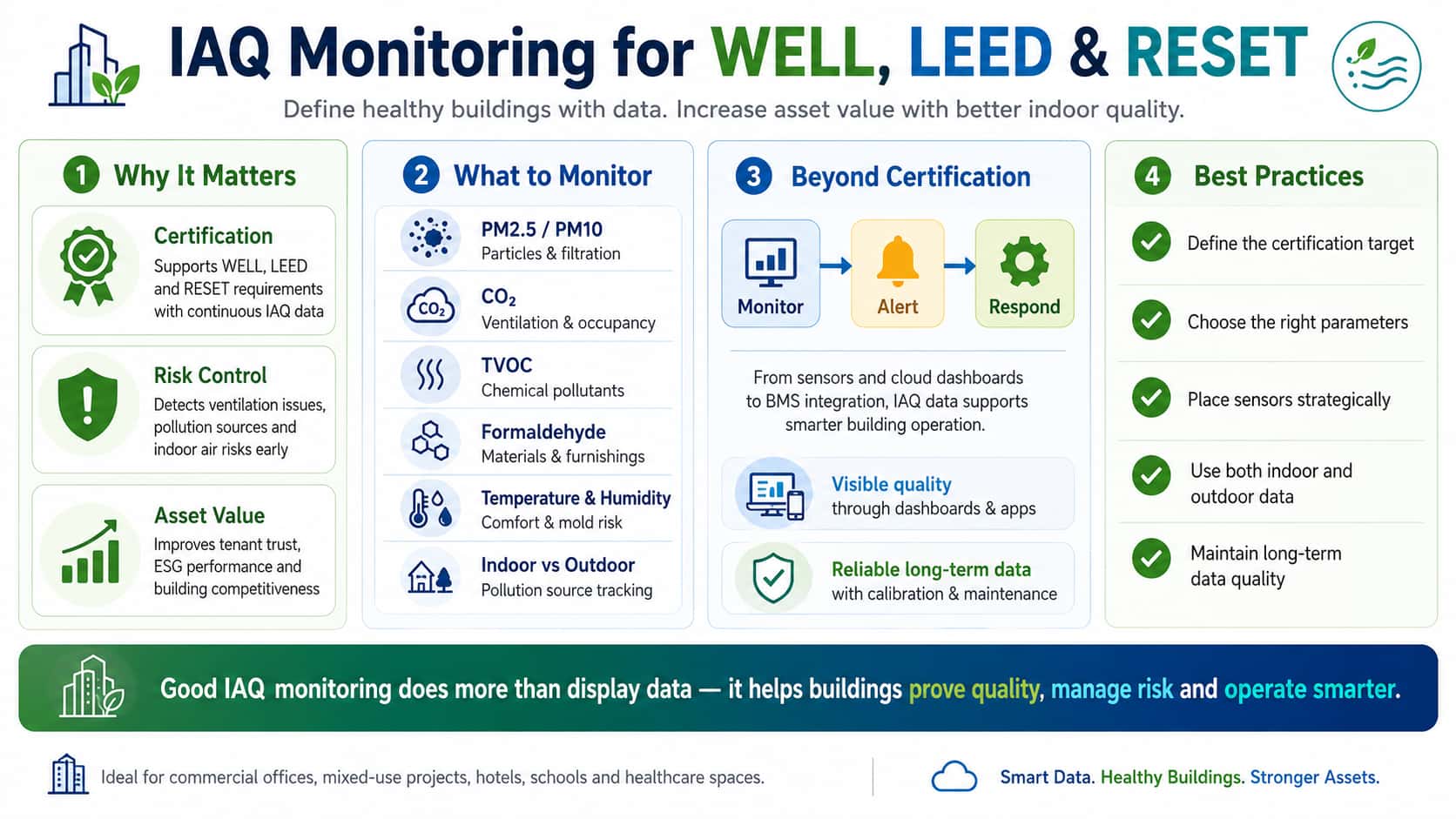
Beyond Certification: From Compliance to Smart Operation
TONGDY’s IAQ monitoring system is more than a certification tool. It can become part of the building’s intelligent operation system.
A Complete Data Loop
From sensor data collection to cloud dashboards and BMS integration, the system supports a full “monitoring-alert-response” workflow.
When air quality changes abnormally, the system can send alerts, support analysis, and help facility teams take action quickly. This turns IAQ data into a practical management tool, not just a display number.
Visible Building Quality
Air quality data can be shown through screens, mobile apps, or online dashboards. For premium offices, commercial complexes, and public spaces, visible IAQ data makes health performance easier to understand and easier to trust.
Transparent data is one of the strongest proofs of a healthy building.
Reliable Long-Term Operation
Continuous monitoring depends on reliable data. TONGDY provides professional calibration, maintenance services, and API support to ensure long-term data stability. This helps buildings meet certification review requirements and maintain consistent performance year after year.
Best Practices for IAQ Monitoring Deployment
To make IAQ monitoring truly valuable, projects should plan the system carefully from the early stage.
Define the Certification Target
WELL, LEED and RESET have different certification logic, documentation needs, and data requirements. The monitoring strategy should be planned according to the target certification system from the beginning.
Select the Right Monitoring Parameters
Different building types face different air quality risks. Offices, retail spaces, schools, hotels, healthcare buildings, and mixed-use developments should select monitoring parameters based on their space functions, occupancy patterns, and operating conditions.
Plan Sensor Locations Carefully
Monitoring points should represent the air quality in real occupied areas. Placement should consider breathing-zone height, HVAC zones, space usage, occupancy density, air supply and return locations, and potential pollution sources.
Combine Indoor and Outdoor Data
Indoor data alone may not be enough to identify the source of pollution. Outdoor monitoring helps facility teams understand whether pollutants are coming from outside or being generated indoors, supporting better ventilation, filtration, and purification strategies.
Maintain Data Quality
Continuous monitoring is not a one-time installation. Calibration, sensor maintenance, data checks, equipment cleaning, and regular system inspections are essential to keep the data reliable.
Only accurate, stable, and continuous data can support certification and long-term building management.
Make Your Building a Healthy Landmark That Breathes
A good IAQ monitoring system does more than show air quality numbers. It helps building managers find problems, understand the causes, and take meaningful action.
As the green building market moves into a more performance-driven stage, competition is no longer just about having a certificate. It is about whether a building can continuously prove its quality.
Whoever controls the data behind indoor air quality will have a stronger voice in defining healthy buildings. Whoever turns IAQ data into operational capability will gain a stronger position in the premium real estate market.
TONGDY helps commercial buildings meet WELL, LEED, and RESET certification needs through professional IAQ monitors, cloud-based data platforms, and long-term operation support.
Contact us today to get a customized IAQ certification and building air quality upgrade solution.
Post time: Jun-10-2026