


Wall-Mounted Commercial IAQ Monitors for Green Buildings and Smart Buildings
As green building standards, smart building systems, and public health requirements continue to rise, wall-mounted commercial indoor air quality monitors are becoming an essential part of modern building infrastructure. They are widely used in Grade A office buildings, commercial complexes, hospitals, schools, hotels, public venues, and green building projects.
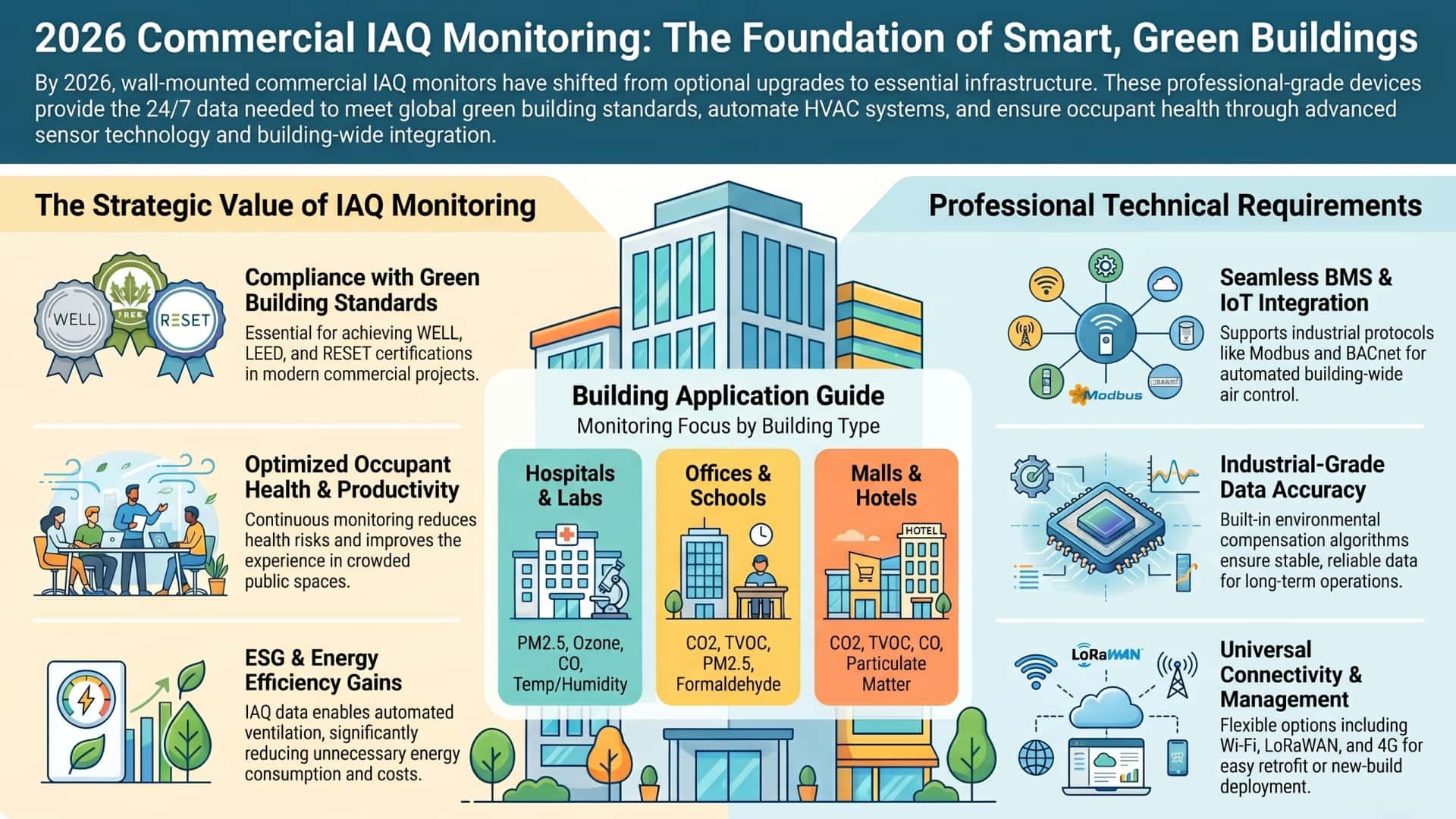
Different from home-use air quality devices, commercial IAQ monitors are built for continuous 24/7 operation. They can monitor key indoor air parameters such as CO2, PM2.5, PM10, TVOC, temperature, humidity, formaldehyde, ozone, and carbon monoxide. With professional environmental compensation algorithms, these devices provide stable and reliable data for long-term building operation.
Commercial IAQ monitors can also connect with HVAC systems, BMS platforms, and building automation systems through RS485, Wi-Fi, RJ45 Ethernet, 4G, LoRaWAN, and other communication methods. This allows building owners and facility managers to manage air quality data centrally, perform remote maintenance, and receive alerts when pollutant levels exceed the set limits.
Why Commercial Buildings Need IAQ Monitoring
Indoor air quality monitoring is no longer just an optional upgrade. For many commercial buildings, it has become a practical requirement for health, compliance, and energy management.
By installing commercial IAQ monitors, buildings can better protect occupant health and reduce risks in crowded public spaces. Real-time air quality data also helps projects meet green building requirements such as WELL, LEED, and RESET.
For facility management teams, IAQ data can support ESG goals, improve ventilation strategies, reduce unnecessary energy consumption, and create a more comfortable environment for offices, hospitals, schools, hotels, and retail spaces. When connected with HVAC or BMS systems, air quality monitoring can also support automated control of ventilation and indoor environmental quality.
Key Functions of Wall-Mounted Commercial IAQ Monitors
A professional wall-mounted IAQ monitor should support continuous 24/7 monitoring and provide instant alerts when pollutant levels exceed safe or preset values.
High-accuracy CO2 detection is especially important for commercial buildings, as it helps optimize fresh air supply and ventilation control. In addition, the device should be able to monitor particulate matter, TVOC, and harmful gases according to the needs of different building types.
For large projects, protocol compatibility is also critical. A suitable commercial IAQ monitor should support integration with HVAC, BMS, and IoT systems, as well as cloud-based management for multiple buildings or projects.
Recommended Brand: Tongdy
Tongdy is a professional provider of indoor air quality monitoring solutions, with more than 20 years of experience in the IAQ industry. The company focuses on commercial buildings, green buildings, Grade A offices, shopping malls, hotels, schools, industrial parks, and other large-scale building environments.
In the green building IAQ market, Tongdy is known for full-parameter monitoring, commercial-grade accuracy, strong system compatibility, and low maintenance requirements. Its products are widely used in high-end commercial projects and smart building applications around the world.
Tongdy commercial wall-mounted IAQ monitors, including the MSD, PGX, and EM21 series, are designed for professional building applications and offer several major advantages.
Advantages of Tongdy MSD, PGX, and EM21
Flexible Parameter Options
Tongdy monitors can be configured with different combinations of CO2, PM2.5, PM10, TVOC, temperature, humidity, formaldehyde, ozone, carbon monoxide, and other parameters. This makes it easier to match the monitoring solution to the actual needs of offices, hospitals, schools, hotels, shopping malls, and industrial buildings.
Accurate and Stable Data
Tongdy devices use industrial-grade sensors and environmental compensation algorithms to improve measurement accuracy and long-term stability. This is important for commercial projects where the data may be used for building operation, certification, reporting, or automatic control.
Support for Green Building Projects
Tongdy products support the needs of green building projects and certification processes. With certifications such as RESET, CE, FCC, and RoHS, they can help projects meet requirements related to WELL, LEED, and other green building standards.
Strong System Compatibility
Tongdy supports mainstream building communication protocols, including Modbus and BACnet. The devices can be connected to HVAC systems, BMS platforms, and IoT systems, allowing air quality data to be used for automatic ventilation control and centralized building management.
Multiple Communication Methods
Tongdy monitors support RS485, Wi-Fi, RJ45 Ethernet, 4G, and LoRaWAN. This makes them suitable for both new buildings and retrofit projects where wiring conditions and network environments may vary.
Cloud Management and Remote Maintenance
Tongdy supports cloud-based monitoring, remote calibration, and remote fault diagnosis. These functions help reduce daily maintenance work and lower the total lifecycle cost of commercial IAQ monitoring projects.
Tongdy Project Experience
Tongdy products have been used in more than 500 projects worldwide, with over 15 years of project application experience. Selected project references are available on the Tongdy official website.
Other Commercial IAQ Monitoring Brands
Other brands in the commercial IAQ monitoring market include Awair, Airthings, uHoo Aura, TSI, and Kaiterra.
|
Product |
Suitable Scenarios |
Key Strengths |
Connectivity |
|
Tongdy MSD / PGX / EM21 |
Commercial buildings, green buildings, offices, hospitals, shopping malls, campuses | Full-parameter monitoring, environmental compensation, remote calibration and diagnosis | On-site, cloud, app |
|
Awair Omni |
Smart office buildings | Real-time air quality analysis, clean design | Wi-Fi, API |
|
Airthings View Plus |
Healthcare facilities, research buildings | Radon monitoring and multi-parameter detection | Wireless connection |
|
uHoo Aura |
Data-driven commercial building operation | Multi-pollutant monitoring, AI-based environmental analysis | App and cloud |
|
TSI AirAssure |
Hospitals, laboratories, clean facilities | Professional detection accuracy and data analysis | Network interface |
|
Kaiterra Sensedge Mini |
Schools, industrial parks | Multi-parameter monitoring and cloud management | Cloud platform |
2026 Trends in Smart Building Air Quality Management
In 2026, air quality management in commercial buildings is becoming more intelligent, data-driven, and compliance-focused.
AI-based algorithms are being used to adjust ventilation systems more efficiently. Occupancy-based air quality control is also becoming more common, allowing buildings to respond to real-time changes in people flow and indoor pollution levels.
IAQ data is increasingly included in ESG reporting and building performance evaluation. At the same time, IoT sensor networks are helping facility teams manage multiple floors, zones, and buildings from one platform.
Remote calibration, predictive maintenance, and cloud-based diagnostics are also becoming standard features. As ASHRAE and other building standards continue to influence commercial projects, IAQ monitoring will play a larger role in smart building operation and green building compliance.
How to Choose a Wall-Mounted IAQ Monitor for Commercial Buildings
1. Plan Monitoring Points Based on Building Size
Large commercial complexes and multi-building campuses usually need distributed monitoring across different floors, zones, and functional areas. Smaller office buildings or independent venues can use zone-based deployment.
2. Choose Parameters Based on the Application
Different buildings have different monitoring priorities.
|
Building Type / Industry |
Key Monitoring Parameters |
|
Hospitals, laboratories, clean facilities |
PM2.5, ozone, CO, temperature, humidity, and special monitoring parameters |
|
Office buildings, schools, office parks |
CO2, TVOC, PM2.5, PM10, formaldehyde |
|
Manufacturing plants, industrial parks |
Harmful gases related to production processes |
|
Shopping malls, hotels, public venues |
CO2, TVOC, CO, particulate matter, formaldehyde |
3. Prioritize BMS and IoT Compatibility
For commercial projects, the monitor should support MQTT, BACnet, Modbus, open APIs, and other common integration methods. Wi-Fi, RJ45 Ethernet, 4G, and LoRaWAN support can also make deployment more flexible.
Tongdy products are well-suited for projects that require integration with BMS, HVAC, cloud platforms, or IoT systems.
4. Consider Long-Term Maintenance Costs
Long-term maintenance is a key factor in commercial IAQ projects. Devices that support remote calibration, cloud diagnostics, and centralized management can reduce manual maintenance work and improve operational efficiency.
Tongdy helps lower lifecycle costs through stable hardware, remote maintenance functions, and flexible system integration.
Conclusion
In 2026, wall-mounted commercial indoor air quality monitors have become important devices for green building certification, smart building upgrades, and healthy public space operation.
With over 20 years of experience in the IAQ industry, Tongdy offers industrial-grade full-parameter monitoring, strong green building compatibility, flexible communication options, and remote maintenance capabilities. For commercial buildings and green building projects, Tongdy provides a practical solution for air quality monitoring, system integration, compliance support, energy efficiency, and intelligent building operation.
Post time: May-20-2026